
Sensing the Reiff
A sensor-based environmental monitoring prototype combining IoT hardware, ambient data logging, and a lightweight web questionnaire to study comfort and satisfaction inside the Reiff building.
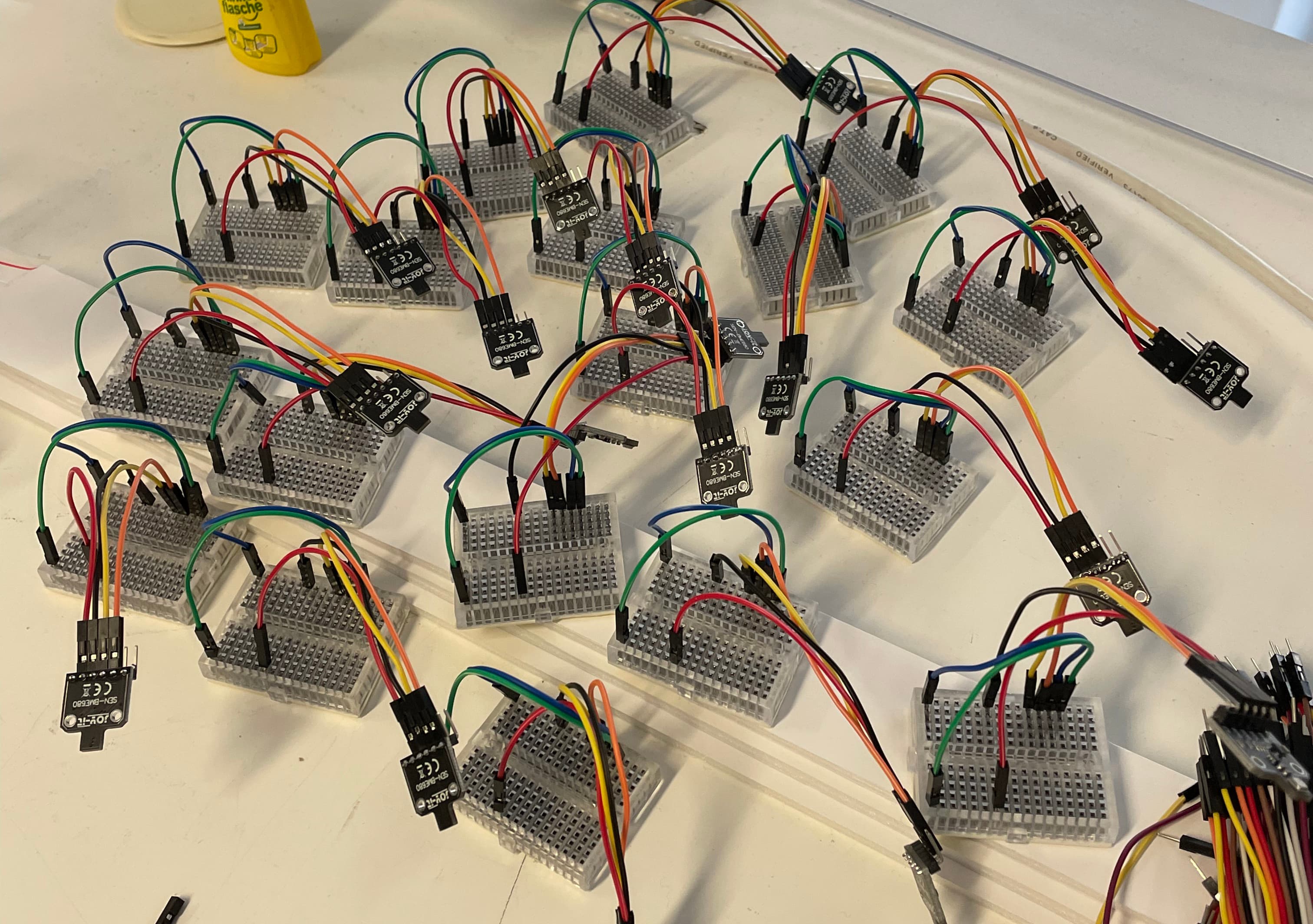
Sensing the Reiff investigated how indoor environmental conditions influence comfort, satisfaction, and perceived usability inside the Reiff museum. The project combined a distributed sensor setup with a lightweight web questionnaire so measured data such as temperature, humidity, air quality, and CO₂ could be read alongside user feedback collected on site. The result was a system-level prototype linking physical sensing, interface design, and environmental evaluation.
- The project explored how environmental conditions in the Reiff building affect comfort, satisfaction, and work quality.
- It combined spatially distributed sensors with user questionnaires to create a more holistic reading of indoor conditions.
- The goal was not only to measure climate data, but to connect quantitative sensing with subjective perception.
- Helped develop the sensing and interface concept for the Reiff environment study.
- Contributed to the web application flow for quick on-site questionnaire participation.
- Worked on presenting environmental measurements and user feedback in a readable, low-threshold format.
- Supported the system framing that linked sensor hardware, building locations, and user responses.
- Mapped the Reiff infrastructure and room selection strategy to determine where sensors and observations would be placed.
- Built a lightweight participation flow using QR-code access and a short mobile-friendly questionnaire.
- Combined ambient sensing hardware with timestamped logging and environmental measurements.
- Reduced the questionnaire to a visually clear five-question flow inspired by ASHRAE, but simplified for faster participation.
- Connected measured variables such as temperature, humidity, air quality, and CO₂ with room-specific user impressions.
- Produced a holistic prototype for evaluating indoor environmental satisfaction through both sensing and feedback.
- Demonstrated how lightweight IoT infrastructure and simple interfaces can support building-performance studies.
- Identified a usable interaction pattern for fast environmental surveys in shared institutional spaces.
- D1 mini development board
- RTC DS1307 module
- MH-Z19C infrared CO2 sensor
- Micro SD Shield
- BME680 ambient sensor
- QR-code-based web questionnaire
Year
2022-2023
Group
Systems
Role
Prototype Developer & Interface Designer
Duration
2 Semesters
Team
Research field group project
Deliverable
Environmental sensing prototype and web questionnaire system
Tools
D1 mini, BME680, MH-Z19C, RTC module, Micro SD Shield, Web questionnaire
Tags